
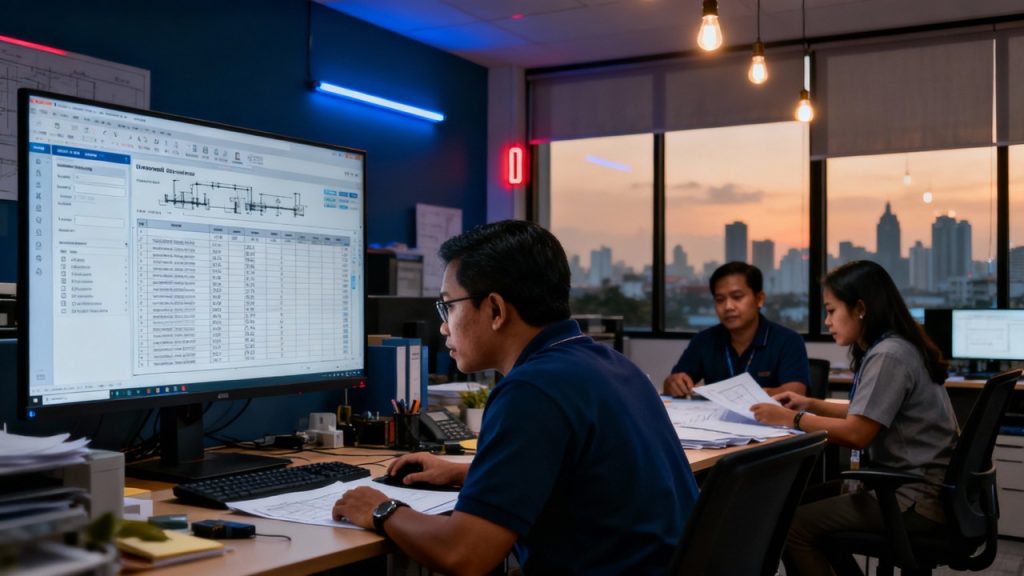
Part 3 of 3: What the Philippines offers
In Part 1, I made the case that offshore success is rarely decided by salary arbitrage alone. In Part 2, I looked at why Latin America can be a strong fit when you need technical depth and long-term stability. Now let’s look at the Philippines.
The Philippines presents distinct characteristics that may serve Australian engineering firms, though in ways that differ from Latin America.
Let’s be clear about what the Philippines offers and what it doesn’t. Mining engineering exists as a regulated profession, but the talent pool is limited. The Philippine Society of Mining Engineers maintains around 2,576 registered members in a country of over 100 million people. If you need deep mining-specific expertise at scale, you’ll face constraints.
What the Philippines does offer is broader engineering capability and strong back-office support. The country’s service-oriented economy has created professionals skilled in supporting international operations. Communication practices have been refined over decades of offshore work, and many Filipino professionals come from environments where working with overseas clients is normal rather than exceptional.
More importantly for many SMEs, there’s a substantial pool of administrative and operational support capability. Document control, procurement and contract administration, and accounting functions are commonly available and can be integrated relatively smoothly. For firms looking to strengthen their back-office capacity and free up Australian staff for higher-value work, this can be genuinely useful.
Where the Philippines shows limitations is in technical project services like planning, scheduling, and cost control. These roles require deeper project management expertise and proactive analytical thinking, which the hierarchical communication culture can inhibit. You’ll find some capability, but it’s not a core strength.
Work Culture
What shows up in practice
When Australian SMEs first engage Filipino teams, several patterns emerge quickly. Some are advantages. Others require calibration.
English proficiency is better than many markets. English is one of the Philippines’ official languages, and many professionals have strong working proficiency. This makes day-to-day communication easier than in non-English speaking markets. But language capability doesn’t eliminate communication challenges when cultural factors are in play.
Strong work ethic with a service orientation. Filipino professionals are hardworking, responsive, and genuinely invested in meeting client expectations. Overtime and weekend work during critical project phases typically meet with willingness rather than resistance. But there’s a trade-off. That same service orientation can make it difficult for them to push back on unclear requirements or unrealistic timelines, because doing so feels like refusing to help. You need to manage this carefully to prevent both burnout and silent acceptance of unworkable demands.
Hierarchical culture creates communication barriers. This is the cultural element requiring the most calibration. Filipino professionals operate within a strongly hierarchical culture where respect for authority is deeply ingrained. This creates practical problems: they may say they understand when they don’t, agree to unrealistic deadlines without raising concerns, or hesitate to deliver negative feedback, all because disagreement or admitting confusion feels disrespectful. For engineering managers, this means you can’t take agreement or silence at face value. You need to actively probe for understanding, create explicit psychological safety for raising concerns, and verify comprehension through structured dialogue rather than assuming clarity.
Retention Dynamics
The Philippines demonstrates strong retention characteristics when managed well. Filipino professionals value relationship investment, recognition, and growth opportunities. The cultural concept of utang na loob (debt of gratitude) creates reciprocal loyalty when employers demonstrate genuine care for employee wellbeing.
The key factor is meaningful engagement. Filipino engineers who feel valued, receive regular feedback, and see clear professional development paths demonstrate strong loyalty. Those treated transactionally will, understandably, respond in kind.
Time Zones
The practical advantage of alignment
There’s a significant operational advantage here. Perth and Manila are on the same time zone (both UTC+8). Sydney is only 2-3 hours ahead, dependiLatin American professionals actually bring to Australian firmsng on daylight saving.
This means real-time collaboration is completely feasible during standard business hours. Urgent issues can be addressed immediately, not overnight. Team meetings don’t require anyone to work unsociable hours. Integration into daily operations is seamless.
For Australian engineering firms that prioritize synchronous communication and rapid response capability, this alignment is a genuine advantage. The question is whether you actually use it.
The Management Reality
The Philippines requires an intensive management approach to work well for complex technical work.
The hierarchical communication challenge
One thing worth understanding early with the Philippines is hierarchy. Respect for seniority is part of the culture, and it often shows up in small, well-intentioned ways. A team member might say “yes” to a tight deadline because they want to be helpful. They might accept a brief that is still a bit fuzzy because asking too many questions can feel like they are being difficult. And sometimes a concern stays unspoken until it becomes obvious in the work.
This can happen even when the relationship is good. People can trust you and still feel awkward pushing back. It’s not about honesty. It’s about what feels socially “safe” in the moment.
Why structure matters more here
If you are not hearing problems early, it does not mean there are no problems. It usually means people are trying to solve them quietly. In engineering, that’s where risk creeps in. Little misunderstandings turn into rework, and small delays turn into bigger ones.
And it is not just the engineers. Even a local team lead can find it uncomfortable to challenge their own team directly, especially if it risks embarrassing someone. The intent is good, but the outcome can be that issues stay below the surface for longer than you would expect.
What tends to work
The good news is you do not need to overcomplicate this. You just need to make it normal to speak up.
Daily check-ins help, but the useful ones are not the “any updates?” kind. They are the ones where you ask people to talk through their thinking. What’s your approach. What assumptions are you making. What could trip us up. What’s the one thing you are unsure about. When those questions get asked regularly, people realise you are not looking for perfect news, you are looking for early truth.
An expat presence also makes a big difference. It’s not about hovering. It’s about modelling the standard. When a leader says, repeatedly, “If something doesn’t make sense, tell me. If the deadline is unrealistic, say so. That’s part of the job,” the team starts to believe it and act on it. You also get better at reading the soft signals. No questions when you expected a few. Updates that feel overly formal. Lots of “noted” and “will do” without much detail. Those are usually moments to pause and ask one more question, not to move on.
The Philippines can be a strong fit when you need back-office and administrative support, value time zone alignment for daily collaboration, and have capacity for intensive structured management. The trade-offs are mainly cultural rather than technical, particularly the hierarchical communication patterns that prevent issues from surfacing naturally. For SMEs that operate through clear systems and documentation, and can commit to active daily oversight consistently, it offers genuine competitive advantage for administrative functions. Without that management investment, expect problems to hide until they become expensive.